
- News
- City News
- vadodara News
- VMC’s recharge wells plan may prove futile: GES study
Trending
This story is from September 23, 2021
VMC’s recharge wells plan may prove futile: GES study
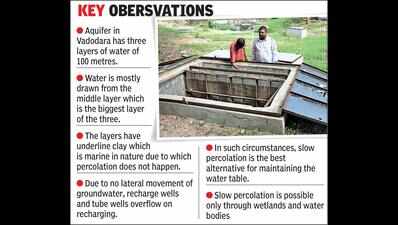
But a hydrogeology study done by city-based Gujarat Ecology Society (GES) suggests that the city needs more wetlands and water bodies to maintain the water table rather than artificial recharge.

The civic body has planned to promote groundwater recharge by building recharge wells in residential societies. While the VMC has proposed to bear the majority of the expenses, the resident welfare associations will have to shell out nearly a quarter of the total expenditure.
The study done by an intern of GES Nirav Dhadankar under the guidance of Dr Jayendra Lakhmapurkar shows that the groundwater in Vadodara city does not have lateral movement as the bedrock is flat.
“If we observe the aquifer along the Vishwamitri river originating from the base of Pavagadh hill, there is a lateral movement till Vadodara city and further after Vadodara city until the river merges with Dhadhar River,” said Lakhmapurkar. “Since there is no lateral movement in Vadodara city, the water recharged through tube wells overflows,” he added.
Researchers suggest that more groundwater bodies and more wetlands with connections for slow percolation of water should be developed instead of recharge wells.
The city has already lost 40 hectares of wetlands since 2005. “Another problem with recharge wells in the city is that they may need regular maintenance as dirt and other particles may get accumulated,” Lakhmapurkar said.
The researchers also raised concerns about the industrialization and concrete developments around the origin of Vishwamitri River. “Due to industrialization and urbanization in Halol, Jarod and Savli, there are high possibilities of groundwater contamination which will affect Vadodara city directly in future,” Lakhmapurkar said.
“Villages near Mahisagar river are complaining about contaminated groundwater due to pollution caused by industries in Nandesari. A similar situation may arise in Vadodara too,” said Dr Deepa Gavali, director of GES. The contaminated groundwater can have several health hazards as neither RO system nor boiling water can purify it.
End of Article
FOLLOW US ON SOCIAL MEDIA







Photostories

Hot Picks
TOP TRENDING
Popular Categories
Hot on the Web
Top Trends
Justin TrudeauIND vs NZ Live ScoreRohit SharmaOmar AbdullahAllan LichtmanJharkhand Election ScheduleSachin TendulkarAkasa Air Flight Bomb ThreatMaharashtra Election Full ScheduleBengaluru FloodKylian MbappesBaba SiddiqueAshes ScheduleRBI Summer InternshipMaharashtra Election ScheduleJharkhand Election ScheduleLive Cricket Score
Trending Topics
Diwali WishesJigra Movie ReviewFake PaneerDevara OTT ReleaseVettaiyan CollectionRam GopalLawrence BishnoiCow GheeBigg Boss 18Salman KhanShraddha KapoorRatan Tata Passed AwayNana PatekarSharad Purnima Moonrise TimeSwatantrya Veer SavarkarSharad Purnima 2024Top Load Washing MachinesBest Premium LaptopsNonstick Cookware SetsWordle Answer
Living and entertainment
Latest News
How Chennai Night Race swerved past challenges to zoom toward a brighter motorsports futureInfosys to no longer send job offer letters and attachments, the company will ...Bigg Boss 18: Avinash Mishra evicted by housemates following major clash with Chum Darang; Eisha Singh and Alice Kaushik left stunnedHappy Govardhan Puja 2023: Top 50 Wishes, Messages and Quotes to share with your loved onesAndre Chase Returns to NXT as Lexis King Defeats Oro Mensah in Gentleman’s DuelAshes 2025-26 fixtures announced: Australia vs England series to begin at Perth'Test cricket is nothing but...' - Indian players reveal what the red-ball format means to themWWE NXT Results and Highlights 10/15: Triple Threat No. 1 Contender match, Stephanie Vaquer vs. Wren Sinclair, and moreActress Helen Nelson aka Oviya files complaint against morphed viral video, takes legal actionRaghav Juyal's VIDEO of getting his shoe lace tied by someone else in public goes viral, netizens react as they get disappointed!Oviya lodges police complaint over her private video leak15-page letter circulating online accuses IBM China head of misconduct; here's what company said while confirming the letter7 deadliest reptiles in the world from venomous snakes to turtlesWayanad bypoll fixed for November 13, Priyanka set for election debutWorld Cup Finals: Sonam Maskar saves the day for IndiaOctober Full Moon 2024 Tonight: When and How to Watch Hunter's Moon?Watch: Two giant pandas Bao Li and Qing Bao arrive in Washington National ZooGSEB Gujarat Board Exam Schedule 2025 Announced: Check complete time table for class 10th and 12th here
Copyright © 2024 Bennett, Coleman & Co. Ltd. All rights reserved. For reprint rights: Times Syndication Service